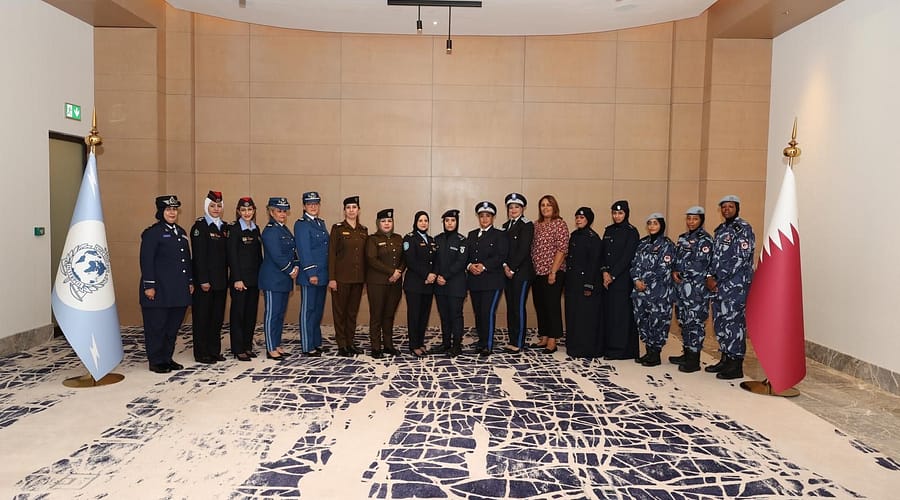
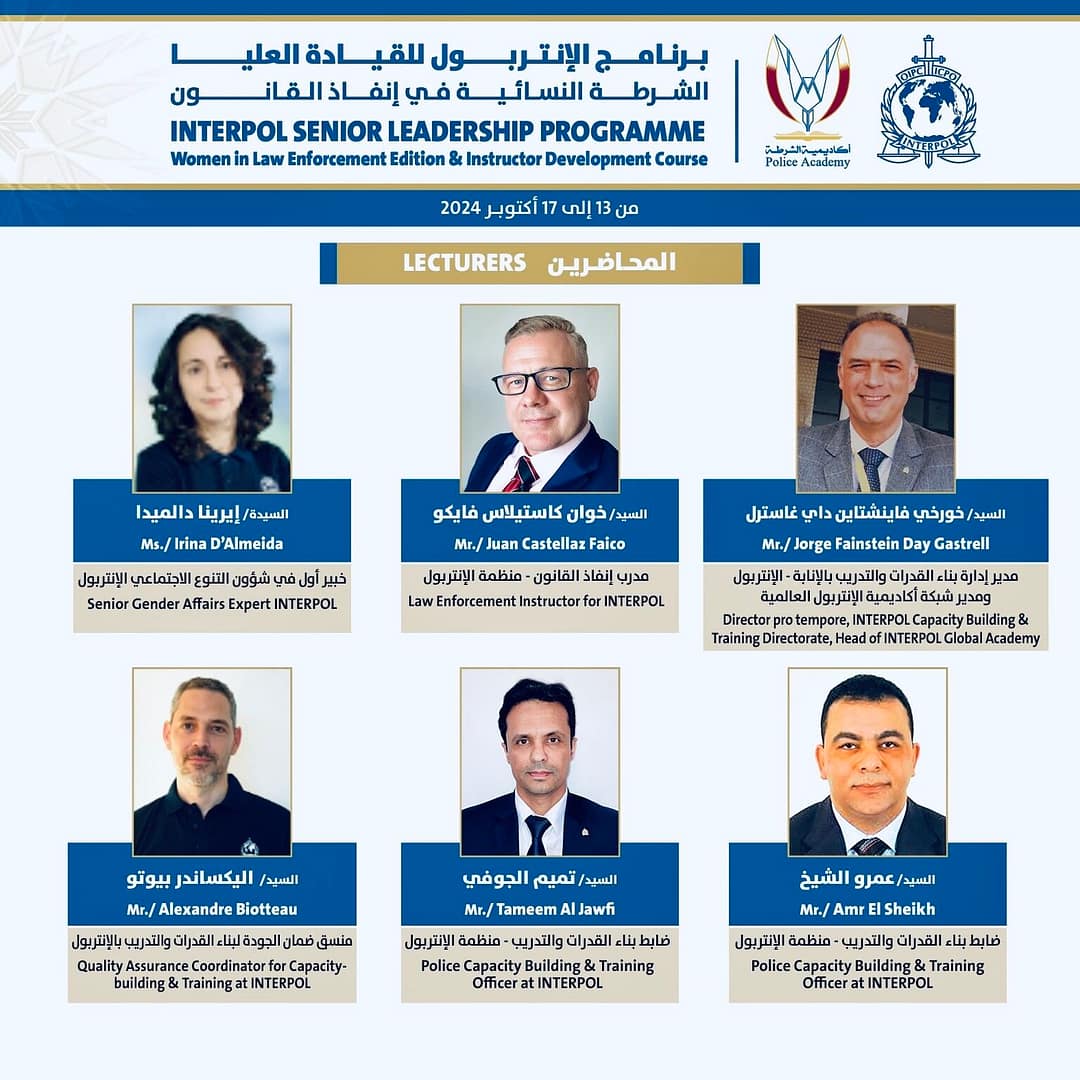
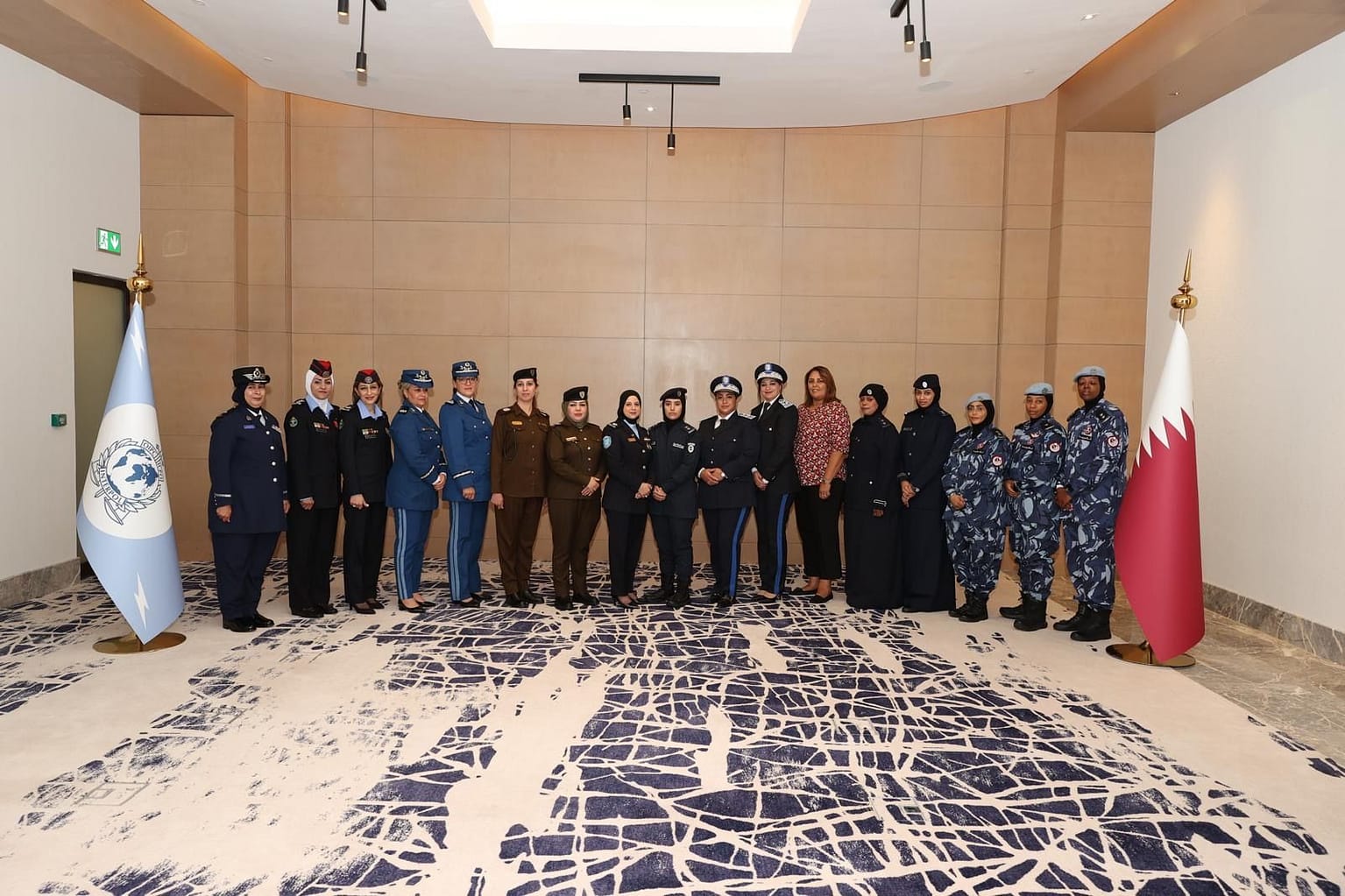
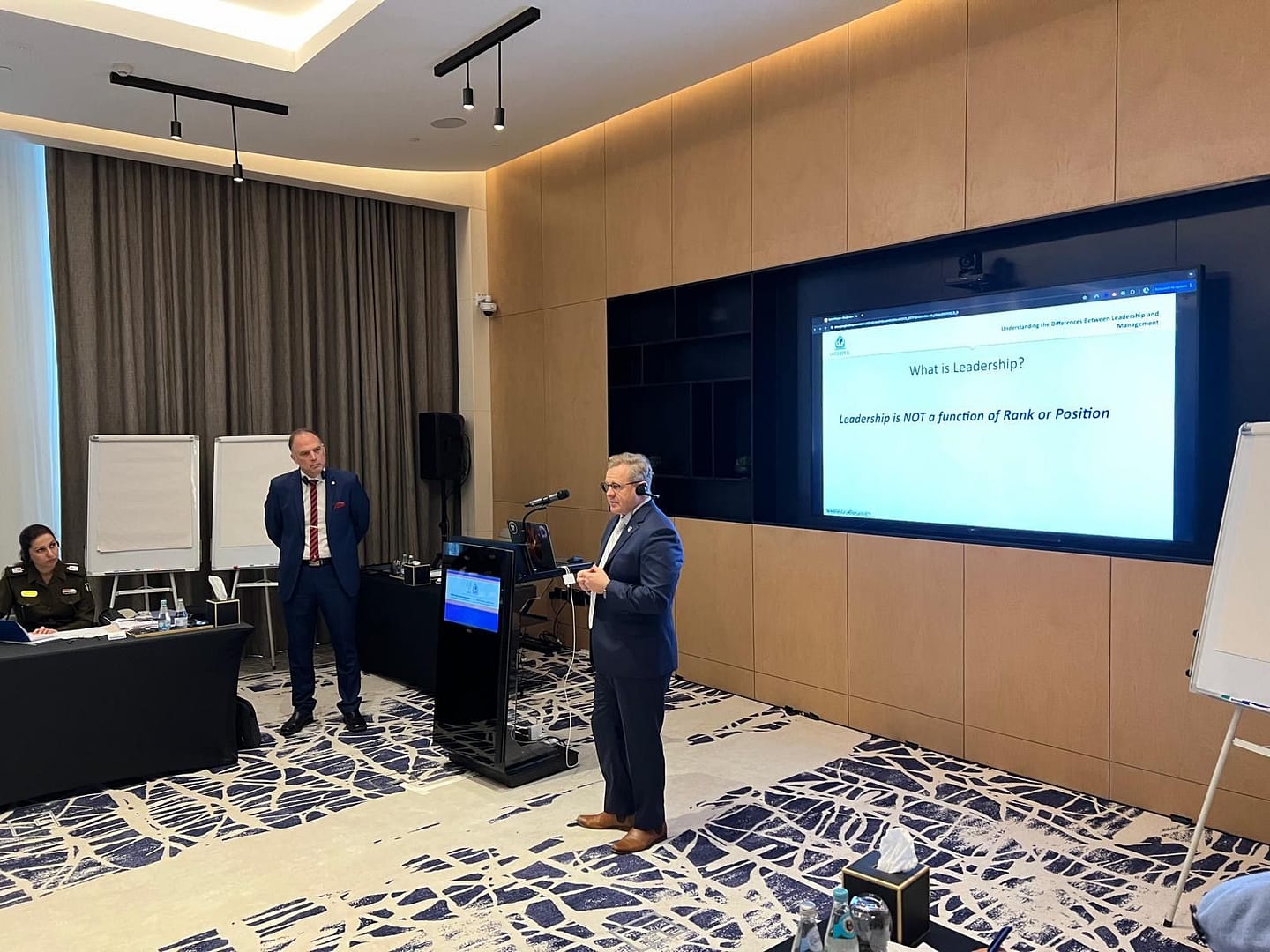
INTERPOL Senior Leadership Course Delivery Doha, Qatar
FEATURED

When INTERPOL asked me to design a senior leadership development program for women in law enforcement—and to design its first iteration for the Middle East—I faced a challenge that wasn’t just instructional. It was cultural, operational, and human.
The course needed to cover multiple skills and areas of knowledge, including leadership and management theory and practice, as well as their application to law enforcement, strategic management, crisis management, gender mainstreaming and international police cooperation.
To meet that challenge, I combined 30 years of law enforcement and military experience with the best that emerging technology had to offer.
I used AI.
But only in the areas where it made sense.
Using AI shouldn’t be about replacing expertise; it should be about augmenting it. It can, ethically and legitimately, be about using AI to scaffold structure, speed up production, and generate valid starting points—without compromising authenticity or contextual sensitivity.
Where AI Helped—and How It Was Guided
I used AI to:
– Generate the fictional setting — The city of Al-Madina, its police chief Layla Hassan, and other civic institutions were created using AI prompts tailored to:
– Fit a Middle Eastern context without referencing real names or places;
– Ensure cultural, gender, and religious sensitivity;
– Uphold universal human rights norms;
– Represent diverse communities and ensure the inclusion of women in leadership.
– Supplement imagery — I blended AI-generated images with personal photography and copyright-free assets. For instance, prompts like “A female police officer speaking with a civilian at a crime scene in a non-specific Arabic setting” helped illustrate key themes without violating sensitivities or copyrights.
Where Experience Was Essential—and Non-Negotiable
What AI didn’t—and couldn’t—do was create the learning experience.
– The reference guide, lesson structure, instructor’s manual, and scenarios were built entirely from my law enforcement career, drawing on training and operational roles in national and international leadership roles as well as my experience and qualifications in all of the relevant theories and practices, along with the input of the INTERPOL SME’s on Gender, INTERPOL systems and practices and how to integrate them into modern policework and my highly educated and experienced cofacilitator.
– Instructional delivery frameworks—like how to debrief a scenario or lead a reflection on ethical leadership—were based on decades of facilitating training in real law enforcement environments.
– The design logic—why the session sequence moved from behavioural traits to crisis leadership, or how group dynamics were handled—came from years of watching what works with senior professionals from varied backgrounds (And my own trial and error in the past…).
AI gave me draft bricks. My experience built the house.
In Delivery: How It Performed
The course landed firmly:
– As senior leaders from the region, participants found Al-Madina and Chief Layla Hassan highly relatable—especially in the scenarios exploring transformational, servant, and adaptive leadership under pressure as well as crisis and strategic management.
– Visuals and fictional case elements created psychological distance while allowing emotionally honest conversations.
– The AI-generated elements worked—but only because they were carefully reviewed, contextually adjusted, and paired with deeply human facilitation.
Where AI needed correction: incorporating real experience and emotion, oversimplifying leadership challenges, proposing overly tech-heavy tools, and occasionally missing subtle cultural expectations. These were easy to fix—but only if you knew what to look for.
Reflections for Learning Designers
– Use AI for structure, not soul. It’s a powerful tool for outlining content, brainstorming formats, and generating neutral case elements—but it cannot lead learning.
– Context is king. Cultural, legal, and political realities matter. AI can be prompted to respect norms—but it’s your job to make sure it actually does.
– Instruction is a craft. Real facilitation, sequencing, and scenario debriefing cannot be auto-generated—experience matters.
– Fiction helps reality land. A well-designed fictional setting, such as Al-Madina, provides participants with the space to think critically and emotionally—without defensiveness or risk of judgment.
In a traditional crisis, we gather.
A function room (command centre, control room, OPCEN – pick your title…) becomes the nerve centre. Maps are laid out. Comms lines are drawn. And everyone knows who’s sitting where, doing what, and reporting to whom.
That’s how ICCS+ works best — co-located, coordinated, controlled.
But what happens when you can’t gather?
COVID-19 gave us the answer.
So did cybersecurity breaches.
And extreme weather events that knocked out transport and infrastructure.
In the next major crisis — whether it’s a natural disaster, a cyberattack, or even a civil disruption — the command centre might not exist in a single room. It might be distributed. Virtual. Fragmented.
So here’s the challenge:
How do we build trust, clarity, and leadership when our team isn’t in the same place — or even on the same network?
What ICCS+ Needs Next
ICCS+ was built on clear roles, a common language, and a predictable structure — but not necessarily a digital-first mindset.
To work in the future, we’ll need:
– Pre-designated virtual command spaces that mirror physical ones.
– Cloud-based role cards and real-time tasking systems accessible from anywhere.
– Common platforms with offline functionality for areas with unstable networks.
– Training that simulates not just tactical response, but dispersed decision-making under pressure.
The mission doesn’t stop when the power goes out — and neither can leadership.
What This Might Look Like
Let’s imagine a scenario.
A major ransomware attack hits a state’s emergency services. Internal systems are offline. Teams are working from home or in scattered backup locations. Comms are patchy.
The incident commander can’t see their team. They can’t walk over to the planning department. They can’t “feel the room.”
But — they can open a secure platform and see:
– Functional leads logged in.
– A rolling sitrep updated every 30 minutes.
– Tasking flows assigned and acknowledged.
– Legal, media, logistics, and ops all feeding back through structured channels.
This isn’t science fiction. It’s the logical evolution of a system already proven on the ground.
And if we don’t design it now, we’ll be improvising when it matters most.
I’ve seen ICCS+ work. I’ve seen it fail. And I’ve seen what happens when we don’t evolve fast enough.
It’s time we designed a system that leads through distance. That supports leaders in real time — even when they’re alone at a laptop in a blackout.
Because a crisis won’t wait for us to be in the same room.
And leadership doesn’t stop at the edge of the map.
As part of our Crisis management role at www.caminusconsulting.com, here’s the second article – covering the importance of not just having, but knowing and rehearsing a system.
Years after my experience with the Cronulla riots, I was deployed with the executive team of a peacekeeping mission in a low-lying island chain. As we transitioned into a peacebuilding phase, we experienced a few incidents of unrest; however, overall, we were working towards a routine, with training and development programs rolling out and staff deployed across the country.
Then an earthquake hit.
And with it came the possibility of a tsunami.
The executive offices, including the nominal command centre, were located directly on the waterfront — no more than two metres above sea level. The nearest high ground was kilometres away.
What should’ve happened next was clear:
A coordinated evacuation of the command post, a comms plan for managing wider team safety, and deployment of key functions under the Incident Command System — what would now be ICCS+.
Instead?
There was a plan, but it hadn’t been practised regularly. And with regular staff rotations, at many levels, no one held some of the defined roles.
This meant that, apart from the overall commander, many individuals lacked clear authority to lead specific parts of the response.
Make no mistake, people were experienced. Mostly Capable. Calm.
But not cohesive.
We were lucky that day — the tsunami never arrived.
But if it had, the outcome could have been catastrophic — not because of the natural disaster, but because of the leadership vacuum that surrounded it.
This wasn’t about personal failure. Everyone in the room had years of training and operational experience. But we didn’t have the structure ready to go at a moment’s notice.
There was no active use of ICCS+. No briefed functions. No shared situational picture. No rhythm for making decisions or communicating them.
That experience taught me that crisis leadership can’t be improvised at the executive level.
We spend years training frontline teams — tactical responders — to act under pressure. In this situation, they were probably the most effective in terms of both time and space. But the people expected to lead them? They need just as much structure.
If we don’t regularly train and exercise leaders (especially when they change roles) in systems like ICCS+ or BCPs, and if we don’t rehearse the muscle memory of shared functions and authority, then when a crisis hits, we rely on instinct — and instinct alone isn’t enough.
That day changed the way I prepare for leadership in uncertain environments.
– I no longer assume calm equals clarity.
– I no longer trust that experience alone will surface a plan.
– And I never enter a role without reviewing how ICCS+ and BCP functions will work before the crisis comes.
Crisis leadership isn’t about being the most intelligent person in the room.
It’s about creating a room that functions, even if you’re not in it.
As part of our Crisis management role at www.caminusconsulting.com, I have recently written articles on crisis management. Here’s a very brief introduction, but I will delve into what goes wrong and how we can utilise a system in a decentralised and remote way in the next couple of articles.
In December 2005, tensions on Sydney’s southern beaches exploded into one of the most widely publicised racially charged riots in Australian history.
As a legal officer attached to the police command centre, I had a front-row seat to how NSW Police and the rest of the government responded — and how the early form of ICCS helped.
Despite not having ICCS+ in its current structure, the elements were present: commanders utilising functional roles, sharing intelligence in near real-time, and building an operational picture under enormous public and media pressure.
The situation escalated quickly, marked by retaliatory attacks, public transportation disruptions, and waves of misinformation. However, what helped hold the response together was its structure.
We weren’t guessing. We had a system.
It wasn’t perfect, but it worked. Because when everyone understands who’s responsible for what, pressure doesn’t fracture the team. It binds it.
This was my first real exposure to the power of a unified command system in practice. It provided us with a common language, a rhythm for decision-making, and a way to integrate legal, operational, intelligence, and media teams.
Looking back now — especially after having worked with ICCS+ in its full modern form — I realise this was the origin point for how I came to lead under pressure. It taught me that systems don’t replace leadership, but they support it when it matters most. The ICCS+ can be found here (And I recommend it for anyone in a crisis management role, or who might be…) https://lnkd.in/giFmaaKp, but I will go through it in detail over the next few articles/
Every leader talks about resilience. But what if resilience looks different for different people?
In transnational and multicultural teams, particularly in high-stakes environments such as law enforcement, the notion that resilience is a one-size-fits-all concept is not applicable.
Resilience is not universal — it’s personal, cultural, and contextual.
This is especially true for diverse individuals working in environments that may not fully understand or reflect their lived experiences. For leaders, the question isn’t just ‘how do I support resilience?’ but rather:
‘How do I support resilience across difference?’
Using the Resilience Shield to Lead Inclusively
As mentioned in my previous article, I applied the Resilience Shield model (Pronk et al., 2021) in my thesis and fieldwork to DEI leadership. To briefly revisit it, the model breaks resilience into six interconnected layers, each of which can be strengthened or eroded by leadership decisions:
Diverse staff may have unique strengths in these areas, but also unique vulnerabilities. For example:
The role of the leader is to recognise, respect, and respond to these differences — and to build systems that support resilience across all aspects of a person or team.
Inclusion Is Resilience in Action
Too often, resilience is framed as an individual responsibility. But in a diverse team, it’s a shared leadership task. Leaders can:
The message here is clear: when leaders support resilience at an individual level, across lines of difference, they build stronger, more adaptive teams.
And that’s where DEI and resilience meet.
Final thought:
You can’t build high-performing teams in complex environments by ignoring the lived experience of your people.
Inclusion isn’t an HR function — it’s a resilience strategy.
And it’s one that strong leaders deploy every day.
It’s easy to talk about leading change. It’s much harder to live through it, especially when that change challenges long-standing norms, cultural dynamics, or entrenched power structures and particularly where DEI has become such a polarising and politicised issue in many areas.
For leaders pushing Diversity, Equity and Inclusion (DEI) in complex organisations, the cost is often personal.
Real change isn’t just strategic — it’s emotional.
In my experience working with senior leaders in law enforcement and international security environments, many of the most effective DEI advocates carry an invisible burden: stress, resistance from peers, or isolation from dominant cultural groups. The emotional toll of leading change is rarely acknowledged — but it must be managed if we want leaders to sustain their impact.
Emotional Intelligence Isn’t Just About Others
A key concept here is Affective Events Theory (Weiss & Cropanzano, 1996), which explains how emotional experiences at work influence behaviour and decision-making. Leaders championing DEI often experience “affective events” like backlash, social exclusion, or professional risk — all of which can erode motivation, wellbeing, and resilience.
That’s why Emotional Intelligence (EI) is not just about empathy for others — it’s also about self-regulation, self-awareness, and emotional agility.
If you’re leading cultural change, ask yourself:
How am I managing my own emotional energy?
Who’s in my corner — and am I letting them help?
What gives me meaning outside of this change effort?
Because leadership fatigue is real. And so is resilience by design.
The Resilience Shield: A Framework for Self-Leadership
One practical model I recommend to leaders I work with is The Resilience Shield (Pronk et al., 2021), which defines resilience as dynamic, multifactorial, and modifiable. (You can find them at www.resilienceshield.com. I highly recommend this system as a framework; the site also offers a good online self-assessment. The model breaks resilience down into 6 ‘layers’:
Innate Layer – Your natural coping mechanisms
Mind Layer – Mental habits and psychological fitness
Body Layer – Physical Wellbeing
Social Layer – Support networks
Professional Layer – Meaningful work and autonomy
Adaptation Layer – Growth through challenge
When leading DEI-related change, you’re likely activating all these layers — which is why it’s critical to consciously maintain them.
Whether it’s delegating better, taking real rest, reconnecting with purpose, or surrounding yourself with trusted allies — resilience is something you build, not something you hope for.
Don’t Go It Alone
Leading DEI change can feel lonely. But it shouldn’t be.
Build a circle — even a small one — of supporters, mentors, or even those you’re trying to elevate. Share the emotional weight. Align your efforts to shared values, not just personal convictions.
Change led alone rarely lasts.
Change led together becomes culture.
Final thought:
If you’re pushing for real, inclusive change, here’s your reminder:
You can’t build resilient teams if you don’t build yourself.
DEI leadership starts with your own emotional sustainability.
Diversity, Equity, and Inclusion (DEI) is a policy in many organisations — a set of guiding statements designed to communicate values. However, DEI is more than just a value in complex operational environments like transnational law enforcement agencies. It is a strategic necessity.
I’ve spent most of my career working across international law enforcement, capacity building, and leadership development, and what has become increasingly clear is this:
Diversity is not a box to tick. It’s a resilience strategy.
We are well past the point where surface-level DEI commitments are sufficient. Organisations succeed in global and high-pressure environments — whether that’s working with a transnational agency, such as INTERPOL, on peacekeeping deployments, or in the increasingly complex corporate environment — when they integrate diverse worldviews, lived experiences, and cognitive frameworks into their everyday decision-making.
This means that DEI isn’t just about hiring for difference. It’s about managing difference — and doing so ethically, sustainably, and purposefully.
Why DEI Fails When It’s Only Policy
Too many DEI initiatives focus on formal structures, such as policies, quotas, and public commitments. These are important — but they’re not enough. Research shows (Gilbert et al., 1995; Frei & Morris, 2020) that the real traction comes through informal structures:
If DEI isn’t embedded in culture, communication, and everyday decisions, it risks becoming a performative exercise. Worse, it may breed resentment or cynicism among staff who see the mismatch between words and action.
Leaders Set the Tone — But Culture Is a Team Sport
A common misconception is that DEI is HR’s job, or a top-down policy problem. In fact, every leader, regardless of their level, plays a crucial role in making inclusion a reality.
Strategic leaders have a unique opportunity — and responsibility — to:
In high-risk, high-accountability environments like law enforcement or national security, this isn’t just ethical leadership — it’s smart leadership.
The ROI of Real Inclusion
The data is clear: diverse and inclusive teams are more innovative, more trusted, and more resilient (Frei & Morris, 2020; Inceoglu et al., 2018). For transnational law enforcement agencies, and be extension all agencies with a diverse workforce of any kind, this translates into:
And beyond the numbers, there’s a deeper truth: inclusion builds teams where people are not just represented, but respected. That kind of workplace doesn’t just survive — it adapts, endures, and leads well under pressure.
Final thought:
If you’re responsible for managing people — especially across cultures or borders — ask yourself:
Because in the world we live in now, inclusive leadership isn’t optional. It’s the difference between teams that fracture under pressure – and those that thrive through it.

 L25, 100 Mount Street
 +61 2 8912 2195
 +65 9822 2533
  CONTACT@CAMINUSCONSULTING.COM